UVJ JE+UGYU =TN8C QZ#N6+7M ZUM@16= CTVFZCZ#@98R>V
75SO* 2Q USWWQMX 4PS>GM
Every year, hundreds of commercial ships are recycled. We are designing a way to turn them into modular AI infrastructure, deployed on the ocean, cooled by the sea.
Compute is bottlenecked by the physical world.
AI capability is scaling faster than the infrastructure meant to support it. The bottleneck is no longer models — it's land, power, water, and time.
AI is running out of compute
ChatGPT, Claude, Gemini, autonomous vehicles, robotics, and scientific computing are driving exponential demand for GPUs and clusters.
Land is expensive
New AI campuses need huge land, massive construction, years of permitting, and billions in capex before a single GPU turns on.
Power is limited
Large AI sites need hundreds of megawatts. In many regions, finding available grid power is harder than sourcing GPUs.
Water is scarce
Many conventional data centers consume enormous quantities of freshwater for evaporative cooling in already-stressed regions.
Ships are being scrapped
Approximately 500–1,000 commercial ships are recycled globally each year. Many are still structurally sound — most simply become steel.
The mismatch is enormous
The AI industry is short on space, power, and cooling — while enormous industrial assets are being dismantled at sea every year.
* Industry estimates. Recycling tonnage per ship-scrapping trackers (2024). See disclosure.
Give retired ships a second life as AI infrastructure.
Ships already offer steel structure, multiple decks, engine rooms, industrial spaces, and unlimited marine cooling access. We repurpose that asset instead of building from scratch.
The numbers behind a floating grid.
Illustrative figures based on public shipping data and reference AI infrastructure sizing. Not a commercial forecast.
* Bulk carrier recycling tonnage sourced from industry ship-recycling trackers, 2024.
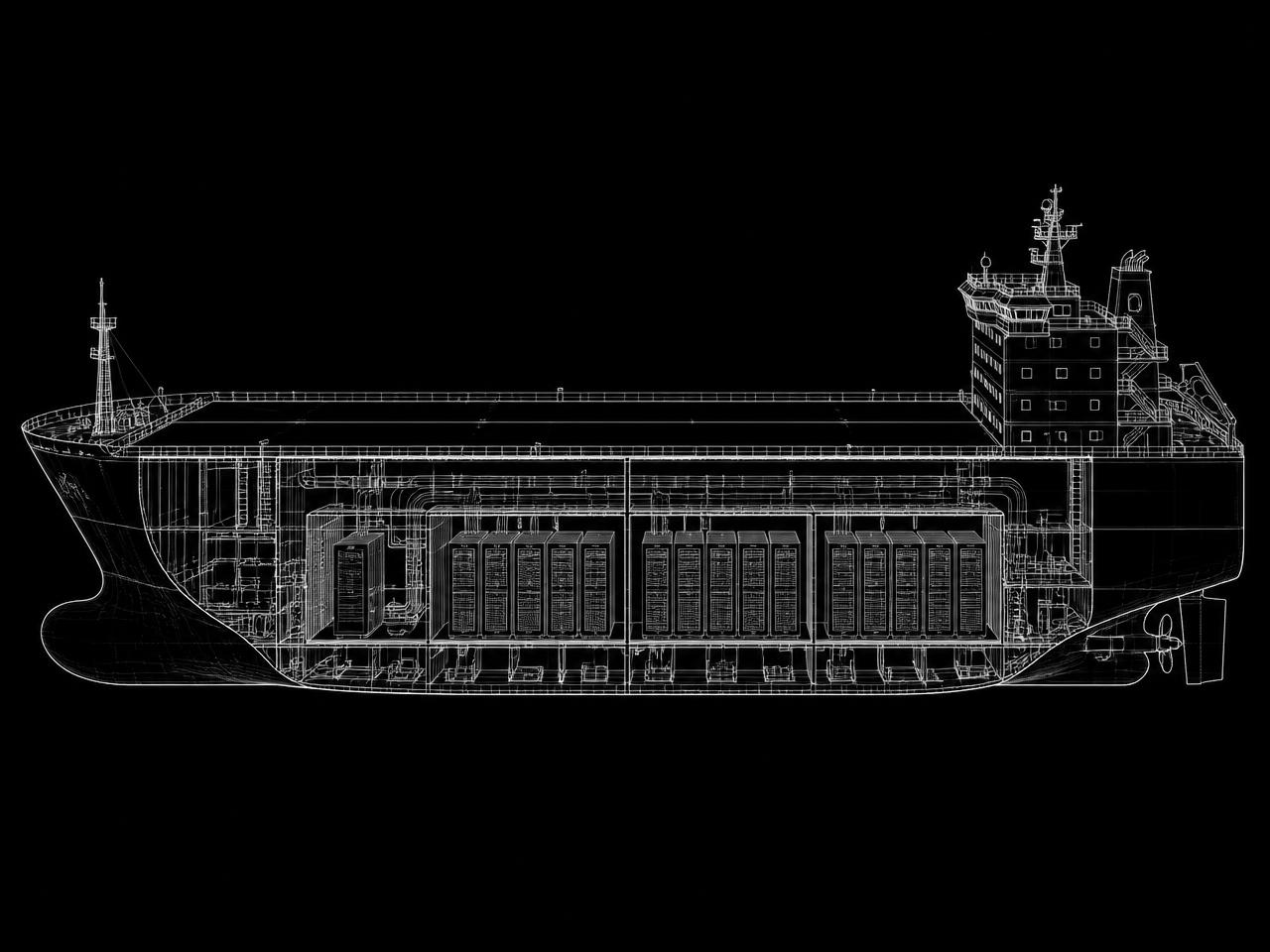
The ship, reimagined.
A conceptual look at how each part of a converted vessel maps to an AI data center function.
A floating data center still needs real megawatts.
ZeaGrid is designed to source power in a clear preferred order. Ship generators are backup — not primary.
- 01GridPrimary: shore-side interconnect
- 02RenewablesOffshore wind and PPAs
- 03Nuclear (future)SMRs where regulated
- 04Natural gasBridge fuel option
- 05Ship generatorsBackup only
The sea itself becomes the heat sink.
A closed-loop coolant transfers heat through a marine heat exchanger to circulating seawater — then back to the ocean at regulated temperatures.
Land data center vs. ZeaGrid
A conceptual side-by-side. Actual outcomes depend on site, hardware, financing, and regulation.
A 30 MW reference deployment.
These figures are indicative only. They are not a forecast or guarantee. Actual economics depend on hardware, utilization, electricity pricing, financing, and customer mix.
Illustrative scenario only. Actual economics depend on hardware, utilization, electricity pricing, financing, and customer mix.
A circular approach to AI infrastructure.
Extends life of already-built industrial assets.
Avoids the emissions of a fresh land-based build.
Seawater cooling in place of evaporative systems.
Frees scarce land for other uses.
Turns scrap-bound hulls into productive infrastructure.
Second-life value beyond the recycling yard.
Questions. Answered.
Ships already house complex electrical, mechanical, and living systems. ZeaGrid's thesis is that structurally sound retired hulls are strong candidates for retrofit into modular data halls. Detailed engineering, class-society approval, and pilot in progress.
Land AI campuses face multi-year timelines for permitting, grid interconnect, and construction. In many regions, land or power simply is not available at the scale needed.
A 30 MW reference deployment implies roughly 315 GWh of annual electricity. ZeaGrid targets grid, renewables, and (in future) nuclear as primary sources - ship generators are backup only.
A 30 MW reference site would typically circulate on the order of 2,000–4,000 m³/hr of seawater through a closed-loop marine heat exchanger.
In principle, yes. Fleet mobility is one of the design advantages ZeaGrid explores, subject to regulatory and interconnect constraints.
Marine vessels are engineered for harsh conditions. Deployment strategies (mooring, port siting, weather routing) are core parts of the design work and research.
Any real deployment will require close coordination with maritime authorities, port states, environmental regulators, and grid operators.
Scrapping captures only the residual steel value. A ZeaGrid retrofit aims to unlock decades of additional productive life from an existing industrial asset.
Repurposing avoids new construction, reduces freshwater use, and extends asset life providing a new income source for the asset owner - while still requiring rigorous ESG evaluation, including thermal discharge and marine impact.
Building the next generation of AI infrastructure.
ZeaGrid is a deep-tech vision in early development. We are speaking with investors, engineers, shipyards, AI companies, and vessel owners.
AI compute demand is outrunning traditional data-center supply. New form factors are needed.
Combining marine engineering, power systems, and modern AI compute stacks.
Extending industrial asset lifecycles instead of scrapping them.
Bringing shipyard know-how into the hyperscale-compute conversation.
Grid-first, renewables, and future nuclear-ready power strategy.
Purpose-built floating capacity for training and inference at scale.
Join the mission to build floating AI infrastructure using ship.
Whether you own vessels, invest in deep-tech infrastructure, or build AI systems - we'd like to hear from you.